
DoNeutS:
A Double Neutron Star Catalogue

The vast majority of NSs are observed as pulsars, rapidly-rotating and highly-magnetized objects emitting beams of radiation along their magnetic axis, which is misaligned respect with the rotation axis. As a consequence, this radiation is seen on Earth as a pulse due to the lighthouse effect (Rezzolla et al, 2018 ), as shown below.
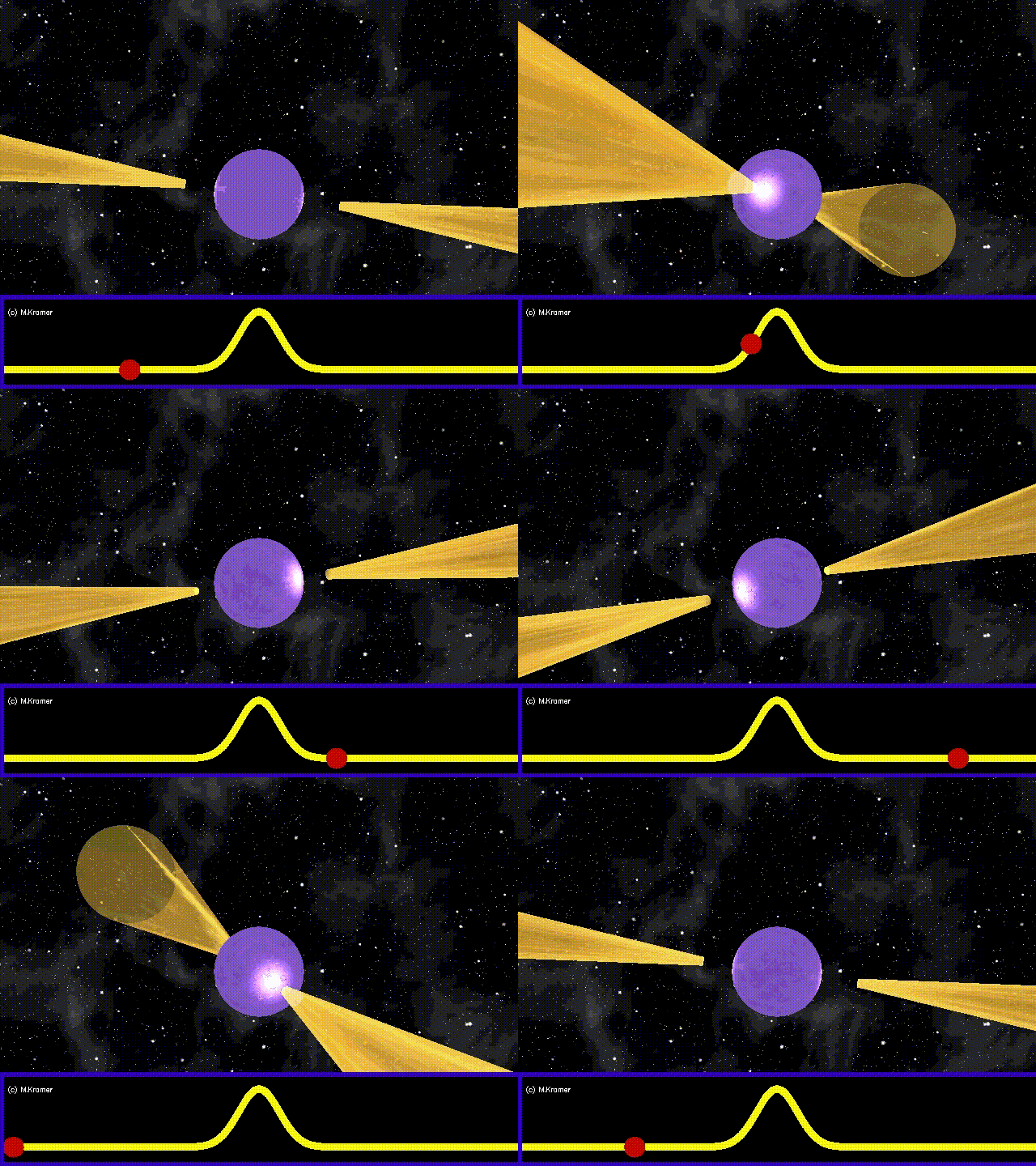
The extreme regularity of pulses, which make pulsars the most stable clocks in the observable universe, makes pulsar timing the most accurate method to determine their masses, as well as test fundamental physics. The procedure consists in monitoring the times-of-arrival (TOAs) of pulses over a period of time to determine the pulsar's rotation period. Thanks to their regularity, small deviations in the TOAs can be detected with precision. The greater the number of collected TOAs, greater will be the precision achieved. Additional parameters of pulsars and its orbits (in binary systems) are also obtained from pulsar timing.
Nowadays, more than 3300 radio pulsars were observed (see ATNF for a catalog of radio pulsars), but only a few aspects of them can be directly inferred from observations, and only a tiny fraction of the total sample allows mass measurements. The majority of detected pulsars are isolated, while mass measurement is mainly based on Kepler's law of orbital motion. Notwithstanding, mass and radius measurement of isolated pulsars recently became a reality with the NICER telescope, but so far only one is available ( Riley et al., 2019).
The orbital motion of binary systems is described by five Keplerian parameters: binary period (\(P_b\)), projection of pulsar's semi-major axis (\(a_p\)) along the line of sight \(x_p = a_p \sin{i}\), eccentricity (\(e\)), time (\(T_0\)) and longitude \(\omega\) of periastron. From Kepler's third law, a mass function for each component (pulsar, \(m_p\), and companion, \(m_c\)) of the binary system emerges: $$ f_p (m_p, m_c, i) = \frac{\left( m_c \sin{i}\right)^3}{\left( m_p + m_c \right)^2} = \frac{4 \pi^2}{T_{\odot}}\frac{x_p^3}{P_b^2}, \tag{1}\label{eq1} $$ where \(T_{\odot} \equiv G M_{\odot}/c^3 = 4.925490947~\mu s\) (G is the gravitational constant, c is the speed of light and \(M_{\odot} \) is the solar mass).
If both functions can be measured, as well as the mass ratio (\(q = m_p/m_c\)), the individual masses can be determined provided the inclination angle \(i\) is known. However, determining this angle with accuracy can be challenging, and the mass function of the companion is only obtained in cases where it is a detectable pulsar or a star with an observable spectrum. In the special case of compact binaries, where the companion is a white dwarf (WD) or a NS, relativistic effects, described in terms of post-Keplerian (PK) parameters, can be observed. These PK parameters are functions of Keplerian parameters and describe the relativistic corrections for orbital motion in GR (Stairs, 2003 ):
The observation of any two PK parameters can allow for unique determinations of individual masses, and if additional parameters are specified, it is then possible to test GR within a very high precision, as shown in Kramer et al., 2021. If only one PK parameter is observed, constrains can be imposed on the individual masses. Accretion torques in binary systems can circularize the orbits and, consequently, many NS binaries have extremely low eccentricities, hampering the measurement of \(\dot{\omega}\) and \(\gamma\). On the other hand, the Shapiro delay of pulses due to gravitational field of the companion is dependent on the orbital inclination, being typically relevant for higly inclined systems. Lastly, detection of orbital decay due to gravitational wave radiation (\(\dot{P}_b\)) is only possible for very short orbits. All these conditions makes mass measurement a challenging task. If relativistic effects are too small, they can go undetected even after years of pulsar timing.
Millisecond pulsars (MSPs) are particullarly interesting. These are pulsars with very short spin periods (\( 1 < P < 30~ms \) and \( \dot{P} < 10^{-19}\)), that have experienced periods of matter accretion from their companion, increasing significantly their angular velocity due to angular momentum conservation. These short periods make MSPs extremely precise for pulsar timing and they are now recognized as the most useful objects to test fundamental physics.